Seasonal Home Maintenance Checklist: Troubleshooting Your Fall Heating Startup
Smelling dust or hearing strange noises during your fall heating startup? Use our seasonal home maintenance checklist to know exactly when to call a pro.


When your heating system stays silent on the first crisp September evening, don't panic. Many early-season failures are minor issues you can safely correct yourself.
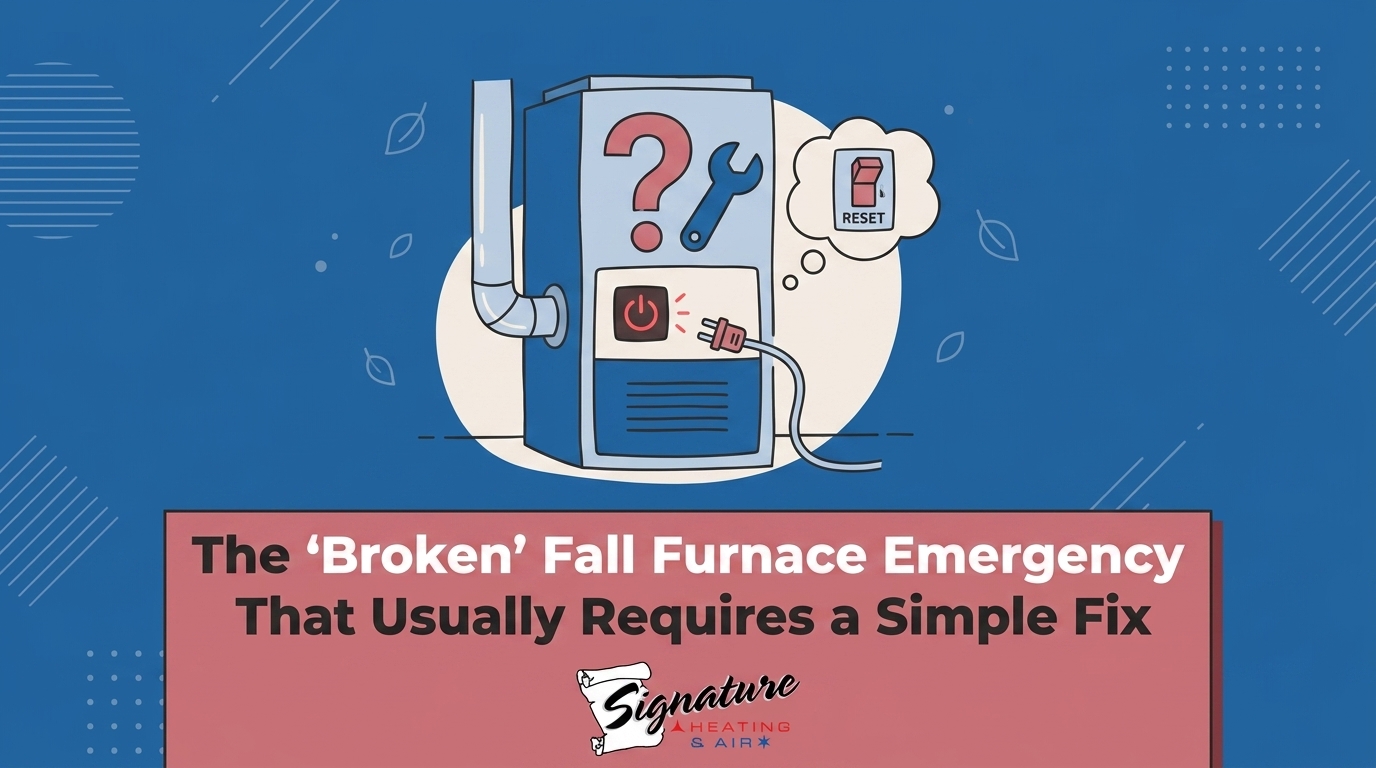
Facing the 'broken' fall furnace emergency that usually requires a simple fix is something almost every local homeowner goes through at least once. Here at Signature Heating & Air, our technicians have seen this exact panic countless times. Early fall is beautiful in Colorado, but the first crisp evening often brings an unexpected and stressful panic. You walk over to the thermostat, switch the system over from cooling to heating, bump up the temperature, and wait for the familiar rumble of the blower motor. Instead, you hear absolute silence, or worse, you feel cold air blowing through the vents. With Centennial's rapid temperature drops—where comfortable daytime highs in the 70s can plummet into the 40s at night—a dormant system suddenly failing feels like an immediate crisis.
Before you assume the entire unit has failed and start bracing yourself for a massive replacement bill, take a deep breath. Many early-season heating failures are minor, self-correctable issues rather than catastrophic mechanical breakdowns. Performing a basic "pre-flight check" on your system can often restore your heat in a matter of minutes. If you want to learn more about how home heating systems operate, or if you need our Centennial HVAC repair team to step in, we are always here to help.
The problem: You turn on the heat for the first time in months, and nothing happens. Every year around late September and early October, our dispatch board fills up with searches and calls about a "furnace won't turn on first time in fall." The immediate assumption is that a major internal component, like the blower motor or the control board, has completely died since you last used it.
The cause: In reality, months of summer dormancy create the perfect environment for minor disconnects. While your heating system sat idle, dust settled over sensitive sensors, batteries slowly drained in the thermostat, and switches may have been accidentally bumped while you were retrieving summer gear or Halloween decorations from the utility room or basement. These issues cause a communication error between the thermostat and the heating unit, rather than a true mechanical failure.
The solution: Understanding the difference between a system that has lost power or communication and a system that is actively broken is the first step toward restoring your comfort. By following a structured, safe troubleshooting process, you can eliminate the most common external culprits before ever needing to call for professional backup.
• Completely blank thermostat screen — Likely Cause: Dead batteries or tripped breaker — Action Required: Safe Homeowner Check
• Thermostat clicks, but furnace stays silent — Likely Cause: Bumped power switch or disconnected door panel — Action Required: Safe Homeowner Check
• System runs briefly, then shuts down — Likely Cause: Severely clogged air filter causing overheating — Action Required: Safe Homeowner Check
• Loud grinding, squealing, or gas odors — Likely Cause: Mechanical failure or gas leak — Action Required: Immediate Professional Repair
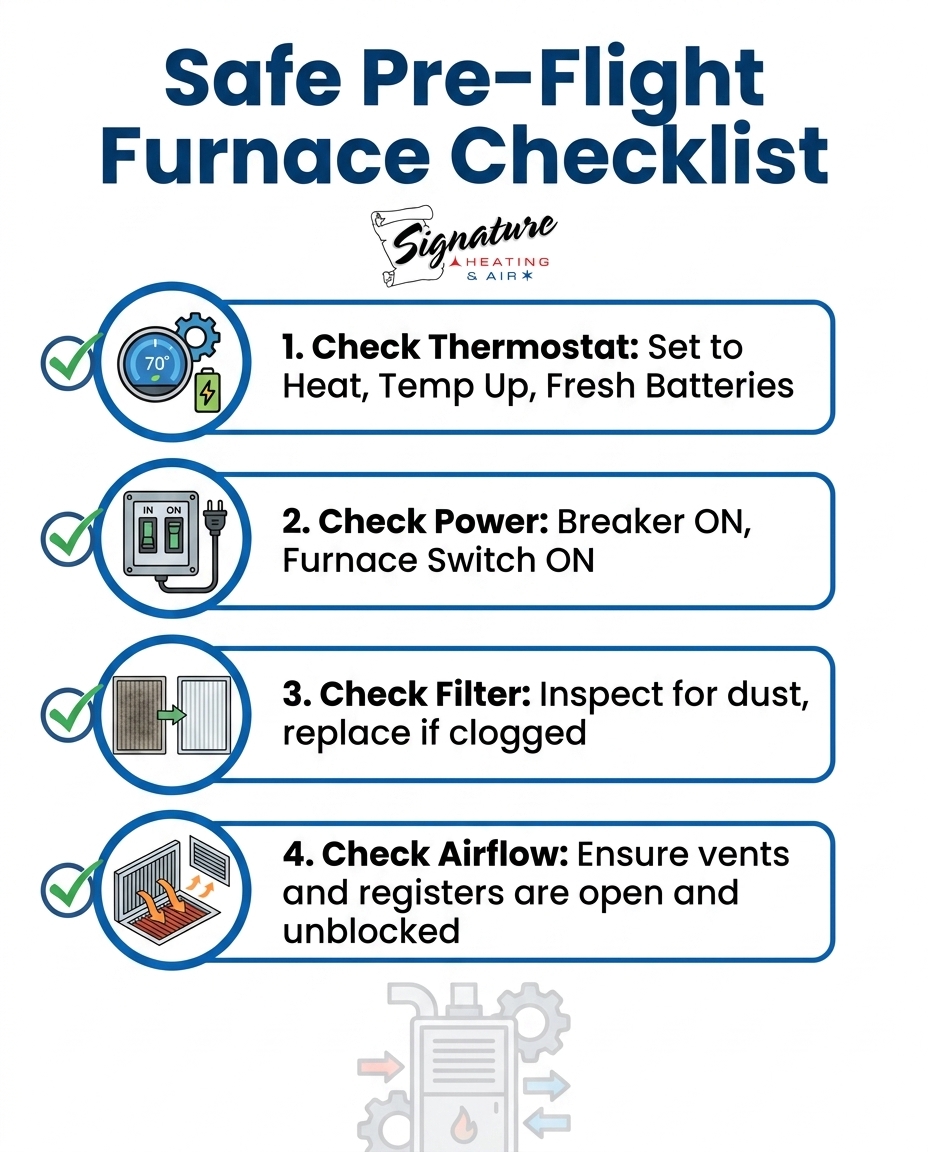
In our years of diagnosing heating systems across Centennial, we've found that the thermostat is often the misunderstood brain of your entire HVAC system. If it cannot send the correct signal to the control board, your heating cycle will never initiate. Start by confirming that the system is actually set to the "Heat" position. It sounds overly simple, but it is incredibly easy to accidentally leave the switch on "Cool" or "Off" during the seasonal transition. Next, ensure the set temperature is at least three to five degrees higher than the current room temperature to force the system to call for heat.
If the settings are correct but the screen is blank or unresponsive, you are likely dealing with a power issue. One local homeowner woke up on a chilly Sunday morning to find their indoor temperature had dropped to a freezing 47 degrees because their system quit overnight. They reached out early, and our team member, Rich, provided quick over-the-phone troubleshooting advice regarding thermostat power that got the system running again instantly, avoiding a weekend dispatch.
Many modern thermostats rely on internal batteries to retain programming and communicate with the main unit, even if they are hardwired to the home's electrical system.
1. Locate the battery compartment: Gently pull the thermostat faceplate straight off the wall mount, or look for a small battery door on the side or bottom of the unit.
2. Use fresh batteries: Remove the old batteries and insert a fresh set of high-quality AA or AAA alkaline batteries. Avoid using rechargeable batteries, as they often do not provide the consistent voltage required.
3. Listen for the click: Snap the faceplate back onto the wall. Wait a few moments for the system to reboot, set it to heat, and listen closely for the distinct "click" of the relay engaging the heating cycle.
The hidden power requirement: A common misconception is that gas furnaces do not require electricity to operate. In truth, your gas heating system relies heavily on electrical power to run the draft inducer motor, glow the hot surface ignitor, open the gas valve, and spin the main blower motor. Without electricity, the gas components will remain safely locked down.
Checking the main breaker: Head to your home's main electrical panel and look for a breaker labeled "Furnace," "HVAC," or "Heating." Sometimes, a power surge during summer thunderstorms can trip this breaker without you ever noticing. If the switch is resting in the middle or "tripped" position, firmly push it all the way to the "Off" position, and then snap it back to "On." A critical safety note: If the breaker immediately trips again, stop. Never repeatedly flip a breaker that refuses to reset, as this indicates a serious electrical short that requires a professional.
The furnace power switch: Next, walk over to the indoor heating unit itself. Somewhere on the side of the cabinet, or mounted on a nearby wall or ceiling joist, you will find a standard-looking light switch. This is the SSU switch, designed to cut power to the unit for safe servicing. Because it looks just like a normal light switch, it frequently gets bumped to the "Off" position by someone moving boxes, retrieving luggage, or cleaning around the utility area during the summer. Simply flip it back up to the "On" position and give the system a few minutes to run through its startup sequence.
A severely clogged air filter is one of the most common, yet easily preventable, causes of HVAC system failures. According to Department of Energy data—and a pattern our Signature Heating & Air technicians see on almost a daily basis during fall tune-ups—dirty filters are a primary culprit behind restricted airflow, which forces the system to work much harder than designed. When airflow is choked off, the heat generated in the combustion chamber cannot be pushed into your ductwork. This causes the internal temperature of the unit to spike dangerously high.
As a safety precaution, your system is equipped with a high limit switch. If it detects this overheating, it will immediately shut down the burners to prevent a fire hazard, leaving you with a system that blows cold air or refuses to turn on at all.
1. Locate the filter compartment: Find the slotted door where the return air duct meets the main equipment cabinet.
2. Slide out the existing filter: Pull the filter out and hold it up to a bright light. If you cannot see any light shining through the pleated material, it is completely choked with dust, pet hair, and summer allergens.
3. Install a fresh replacement: Slide a brand new filter into the slot, ensuring the airflow arrows printed on the frame point toward the main unit (away from the return duct).
4. Reset the system: After replacing a clogged filter, you may need to turn the power switch off and back on to reset the safety limit switch. This simple swap might immediately solve a "no heat" emergency.
The role of proper distribution: Your heating system relies on a delicate balance of air pressure. It needs to pull in a specific volume of air through the return ducts and push out an equal volume through the supply vents. If this balance is disrupted, the system essentially suffocates.
Clearing the pathways: Walk through every room in your house and check that all supply and return registers are fully open. Our team typically sees airflow issues in homes where summer remodeling, new area rugs, or long curtains have accidentally covered these floor or wall grilles. A blocked return vent can easily mimic a broken blower motor by stifling airflow so severely that the system shuts down on safety limits.
The myth of closing vents: Many homeowners mistakenly believe that closing vents in unused guest rooms or storage areas will force more warm air into the main living spaces and save energy. In reality, closing vents increases static pressure inside the ductwork. This restricts the blower motor, harms the system's overall efficiency, and often causes short-cycling—where the unit turns on and off rapidly without ever properly warming the home.
An honest philosophy: It might seem counterintuitive for a heating and cooling company to talk you out of scheduling a service call, but as a local business, the team at Signature Heating & Air would much rather save you an unnecessary emergency dispatch fee than roll a truck just to flip a switch. We've spent years building trust in Centennial CO by empowering homeowners with safe, effective troubleshooting knowledge.
Over-the-phone support: We regularly walk customers through simple issues over the phone. In one instance, a homeowner reached out during a cold snap with a system that wouldn't start. A quick phone conversation guided them through basic troubleshooting, and they resolved the issue themselves completely over the phone—avoiding a service fee entirely. This is a standard part of our customer-first approach.
Safety first: We encourage these specific checks because they are 100% safe for homeowners to perform. Checking a thermostat, swapping a filter, or verifying a breaker does not expose you to high voltage, natural gas, or moving parts. You are simply verifying the external conditions required for the equipment to run properly.
The hard limits of DIY: While external checks are perfectly safe, there is a strict boundary you should never cross. NEVER open the main equipment cabinet to tamper with internal components, attempt to adjust gas lines, or try to bypass safety switches with jumper wires. If the pre-flight checklist fails to restore your heat, it is time to step back.
Signs of a true emergency: If you smell natural gas (often described as a rotten egg odor), hear loud grinding or banging noises, or if the system repeatedly trips the electrical breaker, shut the unit off immediately. These are signs of serious mechanical or safety failures that require immediate professional intervention. Additionally, if you find yourself constantly resetting the system to get it to run, you should review the signs indicating your old furnace needs replacement, as recurring issues often point to an aging unit that is failing internally.
• What a technician looks for: When a Signature Heating & Air technician arrives for a no-heat call, they look past the filter and thermostat. They test the hot surface ignitor for proper resistance, clean the flame sensor to ensure it can detect combustion, and test the control board for proper voltage output.
• The importance of proper tools: Diagnosing internal components requires specialized tools like multimeters, manometers for checking gas pressure, and combustion analyzers. Without these tools and proper training, poking around inside the cabinet is incredibly dangerous. If you have exhausted the basic checks, it is time to rely on our comprehensive HVAC services to safely restore your comfort.
What should I check before calling for furnace repair?
You should always check your thermostat settings, batteries, air filter, and power switches before calling for a repair. Verifying that the thermostat is set to "Heat," the furnace power switch is turned on, the electrical breaker hasn't tripped, and the air filter isn't choked with dust can solve a large percentage of early-season heating failures. These simple DIY steps take only a few minutes and can save you the cost of an emergency dispatch fee.
Why won't my furnace turn on for the first time this season?
Your furnace likely won't turn on for the first time this season due to a minor communication error or a disconnected power source that occurred during its summer dormancy. Dead thermostat batteries, a bumped power switch, or a thick layer of dust on the flame sensor are the most common culprits. Because the system sat unused for months, these small issues go unnoticed until you demand heat on the first cold evening.
Why is my furnace not kicking on?
If your furnace is not kicking on, it is usually because it is not receiving the signal to start, it lacks electrical power, or a safety mechanism has locked it out. Ensure the thermostat is set higher than the room temperature and check the electrical panel for a tripped breaker. If power is present but it still won't start, a clogged filter may have tripped the high limit safety switch.
How do I reset my furnace after it stops working?
You can reset your furnace by locating the dedicated power switch near the unit and flipping it off, waiting 30 seconds, and flipping it back on. Alternatively, you can turn the system off at the main electrical breaker panel. This power cycle allows the control board to reset and clear minor error codes, which often allows the system to attempt a fresh ignition sequence.
Where is the furnace power switch usually located?
The furnace power switch is usually located on the side of the equipment cabinet or mounted on a nearby wall or ceiling joist in the utility room. It looks exactly like a standard residential light switch, sometimes featuring a red cover plate. Because of its appearance and location, it is very common for homeowners to accidentally bump it to the "Off" position during the summer months.
Can a dirty air filter completely stop my furnace from working?
Yes, a dirty air filter can completely stop your furnace from working by severely restricting the necessary airflow. When air cannot flow through the system, the heat remains trapped inside the cabinet, causing the internal temperature to spike rapidly. The unit's high limit switch detects this overheating and immediately shuts down the burners to prevent a fire hazard or mechanical damage.
A cold house on a crisp fall evening doesn't have to ruin your week. By walking through this safe, straightforward checklist, you can often solve the issue yourself and get back to enjoying your evening. If you have checked the thermostat, power, and filter, and your system still refuses to cooperate, don't hesitate to reach out. Contact our Centennial HVAC repair team at Signature Heating & Air to schedule a professional diagnostic and get your heat restored safely and efficiently.


The team at Signature Heating & Air did an excellent job with our new AC installation. They were professional and timely from the onsite quote to the final installation. Their attention to detail was top notch and I highly recommend anyone to give them a call.

I had a very positive experience with all the folks at Signature! Very professional, knowledgeable and honest. They installed a new A/C unit and kept my place clean and they worked with precision and efficiency. Highly recommend them!
I called Signature Heating & Air this morning for a relatively simple job of installing an Ecobee smart thermostat. Quentin came right on schedule and handled it efficiently. He was very helpful and patient to show me how the thermostat worked, etc. Thanks again! I highly recommend this company.
Timely, professional and reasonable pricing. They just replaced both my AC and furnace in about 4 hours. Cleaned up and all is running smoothly. I recommend and will use again when needed.
Steve was great and very professional. He came out and got my HVAC running the same day that I called. I will be using him and his company for my any furnace and AC problems and maintenance.


.webp)
Wisetack - 0% APR up to 24 months (on approved credit)