The 'Broken' Fall Furnace Emergency That Usually Requires a Simple Fix
When your heating system stays silent on the first crisp September evening, don't panic. Many early-season failures are minor issues you can safely correct yourself.



Your indoor ductless unit is blowing warm air, but the outdoor compressor is completely unresponsive. Find out if it's a simple tripped breaker, summer debris, or a serious electrical failure.
When the late summer August heatwaves in Centennial push your cooling system into overdrive, Diagnosing a Silent Mini-Split: What to Check When the Outside Unit Won't Turn On becomes essential knowledge. You walk inside expecting cool relief, but the air blowing from your wall unit feels noticeably warm. When you step outside to investigate, you discover the concrete problem: your indoor unit is running, but your compressor is not turning on. Before panic sets in, know that a silent outdoor unit does not automatically mean your entire system has suffered a fatal breakdown.
When troubleshooting ductless mini-split systems, it helps to understand the difference between a simple safety lockout and a complex electrical fault. Late-summer heat places immense strain on HVAC equipment, leading to extended runtimes that can trigger built-in thermal overload protections. These safety mechanisms are designed to shut the outdoor unit down before permanent damage occurs.
Modern ductless systems are highly intelligent. If the internal sensors detect that the compressor is operating outside of its safe temperature range, the control board will cut power to the outdoor unit immediately. This leaves the indoor air handler running—since it operates on a separate fan motor—while the outdoor condenser goes completely quiet.
As a homeowner, your first step is determining whether this shutdown is a symptom of a minor external issue or a severe internal failure. There is a clear boundary between what you can safely check yourself and what requires professional intervention. While you can easily clear away external blockages or verify that a breaker hasn't tripped, opening the unit's electrical panel is strictly off-limits. Understanding this boundary ensures you stay safe while getting your cooling restored as quickly as possible.
The Problem: You are experiencing a frustrating scenario where the indoor wall cassette is happily blowing air, yet the outdoor condenser remains lifeless. This specific symptom often leads to confusion, as many homeowners assume a broken air conditioner means the entire system will shut down simultaneously.
The Cause: The mechanical separation between the indoor and outdoor components is the root of this disconnect. Your ductless system utilizes an indoor air handler to circulate ambient room air and an outdoor compressor to pump refrigerant and release heat. These two halves communicate via low-voltage wiring, but they operate distinct mechanical parts. If you have a mini split outside unit not turning on, the indoor fan can still draw power and circulate unconditioned air, giving the illusion that the system is partially working.
Depending on your specific model, the outdoor unit usually receives the main high-voltage power supply and then distributes power and communication signals to the indoor heads. If the outdoor unit experiences a localized power loss, a communication failure, or a thermal protection lockout, it will shut down its own fan and compressor. However, the indoor unit may still have enough residual power or independent wiring to keep its blower motor spinning.
• Indoor Air Handler — Primary Function: Circulates conditioned air into the room — Sign of Failure: Blowing unconditioned (warm) air, flashing error lights
• Outdoor Compressor — Primary Function: Pumps refrigerant and releases absorbed heat — Sign of Failure: Completely silent, fan blades not spinning
• Communication Wire — Primary Function: Sends operating signals between units — Sign of Failure: System unresponsive to thermostat changes
The Solution: Recognizing that the indoor and outdoor units operate semi-independently is the first step in diagnosing the issue. Because the indoor unit is still functioning, you can rule out a total home power failure. Instead, this symptom specifically points to a localized power interruption at the exterior disconnect box, a tripped dedicated circuit breaker, or a safety lockout triggered by an overheating compressor.
Before calling for a repair, there are a few safe, non-invasive electrical checks you can perform without ever opening the unit's casing. Heatwaves push cooling systems to their maximum amp draw, which can easily overwhelm older electrical panels in Centennial homes. Verifying your power supply is a crucial first step in any complete mini-split troubleshooting guide.
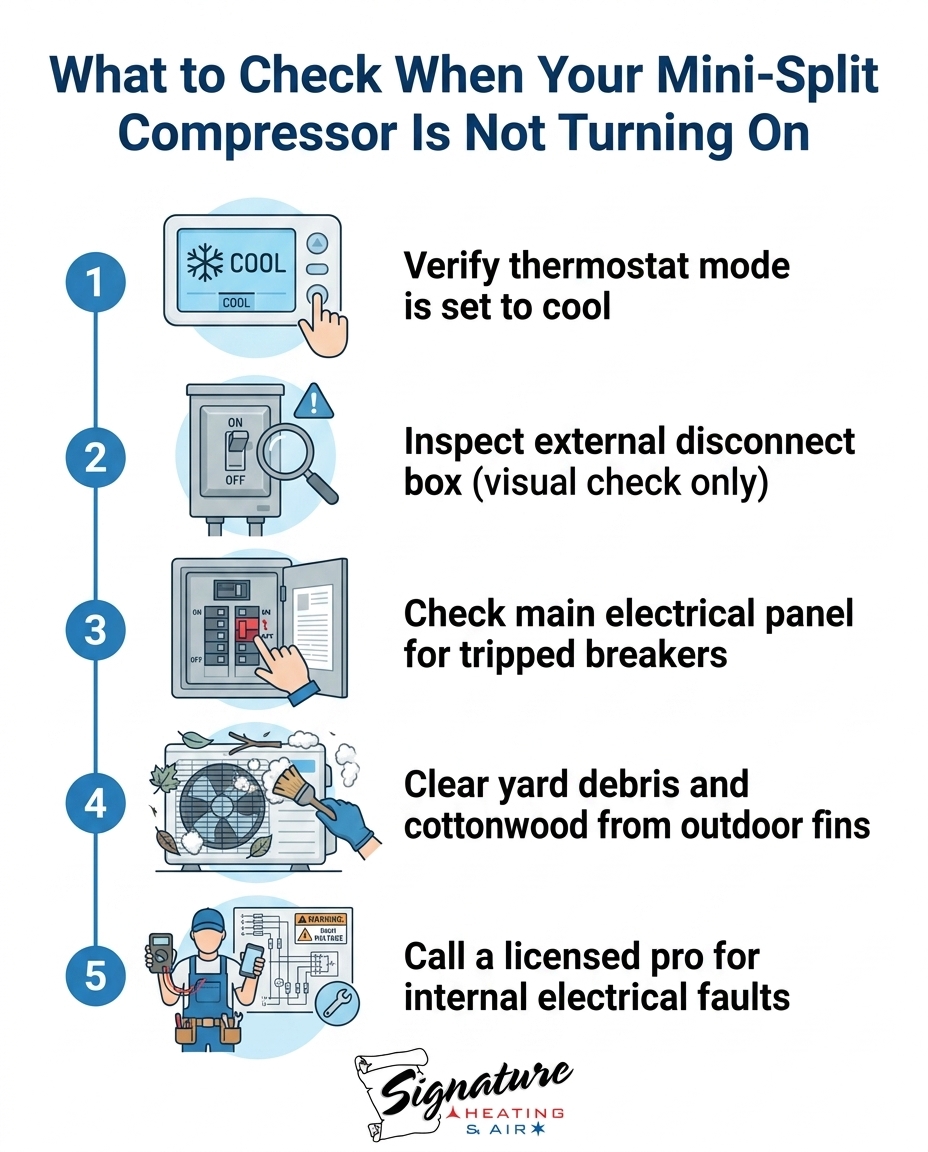
1. Locate the external disconnect box: Find the small metal box mounted on the exterior wall near your outdoor condenser. This box contains a physical switch or a pullout block designed to cut power to the unit during servicing.
2. Perform a visual inspection: Ensure the switch is securely in the "ON" position. If it features a pullout block, verify that it is pushed in completely. Do not open the inner panel to inspect the wiring or fuses, as this exposes you to live high voltage.
3. Check the main electrical panel: Go to your home's main breaker box and locate the dedicated circuit for your ductless system. Look for a breaker that has moved to the middle, tripped position.
4. Reset the breaker safely: If the breaker is tripped, push it firmly to the "OFF" position until it clicks, then push it back to the "ON" position.
5. Monitor the system: Turn your thermostat back to cooling mode and wait ten minutes. If the breaker immediately trips a second time, leave it off. A breaker that trips twice indicates a serious short circuit that requires immediate professional help.
A typical pattern we see involves homeowners assuming the worst about their silent systems. Recently, a local customer thought an expensive replacement part was needed for their ductless setup. Over the phone, a technician explained that the part was not needed and walked them through safely resetting the system at the main breaker instead. The system reset successfully, and the customer learned how to prevent the trip from happening again. These external checks are safe and effective, provided you never attempt to open the equipment itself.
If your electrical panel and disconnect switch are functioning properly, the next most common culprit is restricted airflow. Your outdoor unit relies on a steady flow of ambient air to pull heat away from the refrigerant coils. When that airflow is blocked, the heat cannot escape, causing operating temperatures to spike rapidly.
The specific climate conditions in our region play a massive role in system performance. Centennial experiences significant cottonwood shedding and dry August conditions that create the perfect storm for HVAC issues. The fine, sticky cottonwood fluff acts like a dense blanket, wrapping itself around the tiny aluminum fins of your outdoor condenser. Combined with dry leaves, overgrown vegetation, and general yard dust, this debris quickly suffocates the unit.
How thermal shutdown occurs:
• Restricted heat transfer: The blanket of debris prevents the fan from pulling air through the coils.
• Rising pressure: Because the heat cannot dissipate, the refrigerant pressure inside the compressor rises drastically.
• Overheating: The compressor motor begins to overheat as it struggles to pump the high-pressure refrigerant.
• Safety lockout: The internal thermal overload safety switch activates, shutting the entire outdoor unit down to prevent catastrophic motor failure.
Safe debris removal: You can safely clear external debris to help your system breathe. First, ensure the power is completely turned off at the disconnect box. Use a soft brush or your hands to gently remove large leaves and heavy cottonwood buildup from the outer grilles. You can use a standard garden hose on a gentle shower setting to rinse the fins from the outside in. Never use a pressure washer, as the high-pressure water will instantly flatten the delicate aluminum fins, permanently ruining the unit's efficiency.
While a gentle exterior rinse helps, severe internal clogs deeply embedded in the coil require professional cleaning. A severely restricted coil can cause up to a 30% loss in system efficiency. Investing in routine AC maintenance ensures these deep cleanings happen before the late-summer heatwaves push your system into a thermal lockout.
The internet is filled with DIY repair videos that encourage homeowners to grab a multimeter and start testing internal components. When dealing with a silent outdoor unit, following these online tutorials crosses the line from basic homeowner maintenance into dangerous territory. Internal electrical diagnostics require specialized tools, rigorous safety training, and a deep understanding of high-voltage circuits.
One of the most common causes of a silent compressor is a failed dual run capacitor. This small, cylindrical component acts as a massive battery, providing the initial jolt of electricity needed to start the compressor and fan motors. What many online tutorials fail to emphasize is that a capacitor stores lethal amounts of electrical energy, even after you have completely disconnected the main power to the unit.
Attempting to test or discharge a capacitor without proper insulated tools and training can result in severe injury or worse. Furthermore, a silent unit could be the result of a burnt wiring harness, a failed control board, or a seized compressor motor. Diagnosing these complex issues requires testing live voltage—a task that should only be performed by a licensed professional.
Our local technician expertise means we understand how to navigate these hazards safely. We prefer to help you avoid a service call if it is a simple external reset. For example, another local customer recently reached out about a sudden shutdown. A technician walked the customer through safe external troubleshooting over the phone, resolving the simple issue without an unnecessary service visit. However, we draw a hard line at internal electrical hazards. If your breaker is fine and the coils are clean, the internal panel must remain closed until a professional arrives.
A mini split compressor not turning on is typically caused by a tripped circuit breaker, a blown fuse in the disconnect box, a failed capacitor, or a thermal overload lockout. The system is designed to protect itself from catastrophic failure by shutting down when it detects unsafe operating temperatures or electrical irregularities. If the unit overheats due to dirty coils, the internal safety switch will cut power to the compressor immediately. Resolving the issue requires identifying whether it is an airflow restriction or an electrical fault.
You can safely check a mini split disconnect box by performing a visual inspection to ensure the external lever or pullout block is securely in the "ON" position. Do not open the inner metal panel to expose the wiring or attempt to test the fuses yourself. If the internal fuses are blown, it indicates a larger electrical surge or short circuit. A licensed professional must replace these fuses and test the surrounding components to ensure the system is safe to operate.
Yes, severe dirt or debris blocking the outside unit will absolutely cause a mini split to stop working. When yard debris, such as cottonwood fluff or dry leaves, clogs the condenser fins, it blocks the airflow necessary for heat transfer. This causes the compressor to overheat rapidly and trip its internal thermal limit switch. Regular cleaning and seasonal maintenance prevent this specific type of sudden shutdown and keep the system running efficiently.
Yes, the indoor fan operates independently and will continue to circulate room-temperature air even if the outdoor condenser has lost power. Because the indoor air handler has its own blower motor, it can continue to draw power and run, giving the false impression that the system is functioning. If you feel warm air blowing from the indoor unit, it is a clear indicator that the outdoor compressor is either locked out or lacking power.
To reset your mini split outside unit, start by turning off the system completely at the indoor thermostat or remote control. Next, locate the dedicated breaker in your main electrical panel, flip it to the "OFF" position for 30 seconds, and then flip it firmly back to the "ON" position. Turn the thermostat back to cooling mode and wait for the system to engage. If the breaker immediately trips again, leave it off and call a professional immediately.
Dealing with a silent outdoor unit during an August heatwave is stressful, but understanding the boundaries of safe troubleshooting puts you in control. While checking your electrical panel for tripped breakers and clearing away late-summer yard debris are excellent, safe steps, persistent silence from your system indicates a deeper electrical fault. If your compressor is not turning on after performing these basic external checks, it is time to bring in an expert.
You do not have to suffer through the heatwave with a malfunctioning system, nor should you risk your safety by opening the electrical panel. When the simple fixes don't work, trust a licensed technician to handle the complex diagnostics. Reach out for professional AC repair in Centennial to accurately identify the electrical fault and restore your home's comfort safely and efficiently.


The team at Signature Heating & Air did an excellent job with our new AC installation. They were professional and timely from the onsite quote to the final installation. Their attention to detail was top notch and I highly recommend anyone to give them a call.

I had a very positive experience with all the folks at Signature! Very professional, knowledgeable and honest. They installed a new A/C unit and kept my place clean and they worked with precision and efficiency. Highly recommend them!
I called Signature Heating & Air this morning for a relatively simple job of installing an Ecobee smart thermostat. Quentin came right on schedule and handled it efficiently. He was very helpful and patient to show me how the thermostat worked, etc. Thanks again! I highly recommend this company.
Timely, professional and reasonable pricing. They just replaced both my AC and furnace in about 4 hours. Cleaned up and all is running smoothly. I recommend and will use again when needed.
Steve was great and very professional. He came out and got my HVAC running the same day that I called. I will be using him and his company for my any furnace and AC problems and maintenance.


.webp)
Wisetack - 0% APR up to 24 months (on approved credit)